Tuesday, May 4, 2010

Nice, Côte d'Azur, France

Iceland's Eyjafjallajokull volcano forced a cancellation on my conference in Nice, yet I had to get to Nice to catch my TGV train to Paris, so I had a few hours layover. Nice was still in a winter European weather pattern in late April, drizzly and then some, but as I beelined for the Promenade des Anglais, I could not imagine a more "azure"-colored Mediterranean Sea, grey sky notwithstanding. Heading north I pass through the Jardin d"Alsace Lorraine, with lovely views of art deco buildings surrounding.

Near the return to the train station is the onion-domed St. Nicholas Russian Cathedral, the largest one outside of Russia, built in 1912, due to the generous gift of Tsar Nicholas II. Interestingly, there is currently a dispute over ownership of the property, the current occupants claiming it as an inherited gift from tsarist Russia, yet the Russian government has dispatched attorneys to make a case to France that the Russian church has rights of ownership.


Fond Bayard, Haïti

Fond Bayard is a rural village up in the hills beyond the Riviere de la Grand'Anse. On the way along the coast we passed an old shipwreck in the surf on a sandless beach consisting of the smoothest stones imaginable. The nearest water is a 45 minute hike in the woods to the local spring. Huts are typical tin and sticks. Most of Haiti lives in this rural environment with no electricity or safe potable water.


Place Charmant, Jérémie, Haïti

We had the pleasure to stay at Place Charmant in Jeremie while working with the Haitian Health Foundation (HQ in Norwich, CT). Situated high up in the hills above town, we had sweeping views of the blue waters of the Golfe de la Gonave to the north. Local flora included soursop, which is called corisol in Creole, a key ingredient of a Haitian drink. The red flowers are Christmas poinsettia. The water jugs are authentic slave ship survivors.


Monday, May 3, 2010

Dame-Marie, Haïti

In Haiti, traveling to the end of the line is really saying something. Dame-Marie is truly the end of the road, a long serpentine dirt one from Jeremie heading up into the hills along the Riviere Grand'Anse. Four hours of potholed red clay road. The guide book claims it is one of the few villages in Haiti with paved streets, all cobblestone.

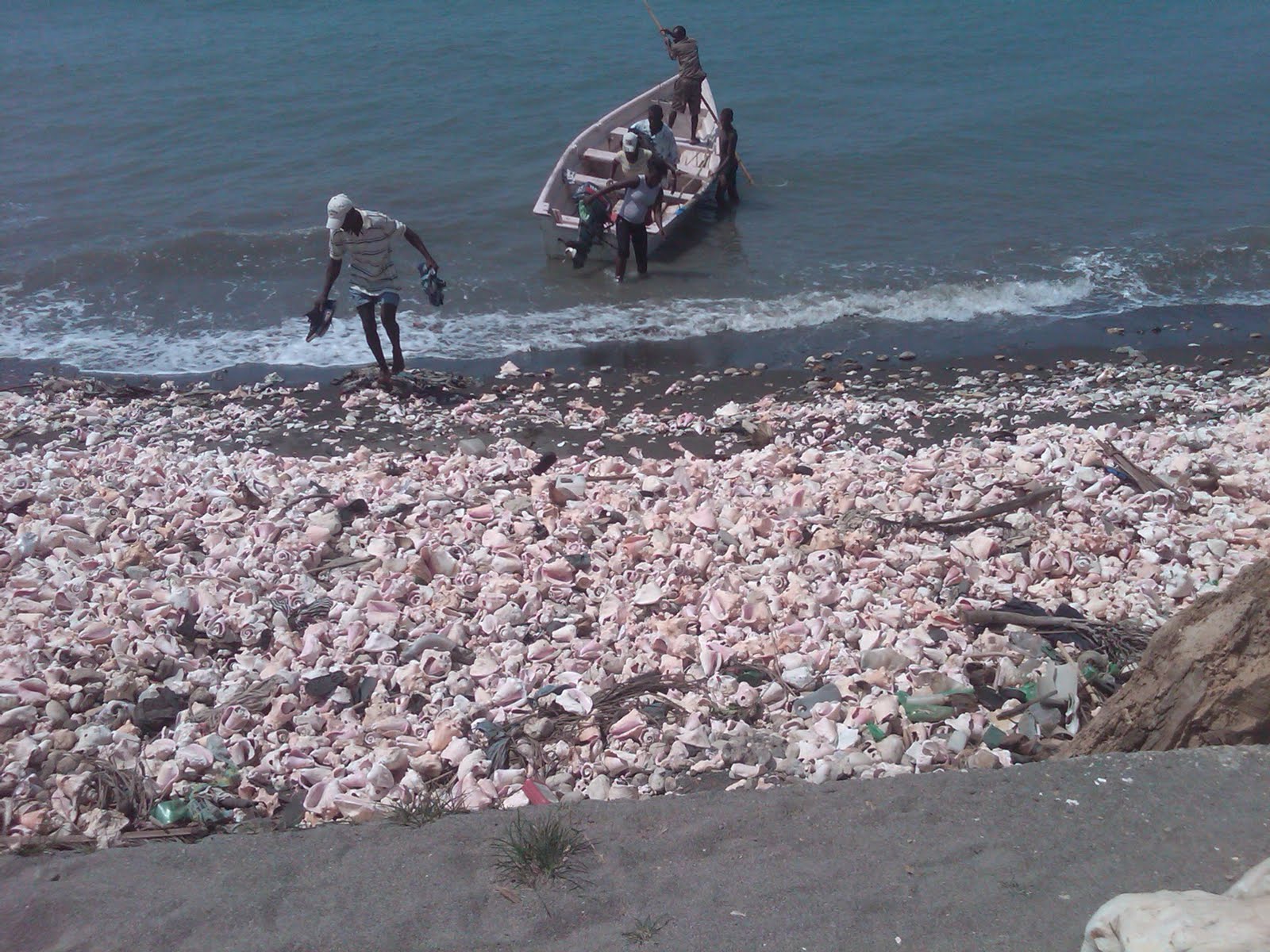
The beach at Dame-Marie is the westernmost point of Haiti. Several dugout canoes could be spotted on the beach. That day, the seas were too rough for the fishermen to catch lobster. And all along the shore, the beaches were covered with spent conch shells, in some places were veritable conch dumps. At the center of town, a beautiful sparkling blue cathedral.


Sunday, May 2, 2010

Market, Jérémie, Haïti

The produce market in downtown Jeremie was a sight to behold. Cinnamon, anise, cloves, pepper, rock salt and other spices in open bins, fish laid out, meat collecting thousands of flies, and a large Mahi Mahi riding a motorcycle....need I say more ? Everywhere, children mugging for the camera.


Jérémie, Haïti

Jeremie is the capital city of Department Grand'Anse, on the southern peninsula of Haiti. The mulatto general Alexander Dumas, whose son wrote The Three Musketeers, was born in Jeremie.

Jeremie is right out of a Hollywood film set, imagine what Africa looked like 100 years ago, what a great place to film a movie. Downtown does not appear to have any new construction since the 19th century. The buildings are fabulous relics of early French architecture, with wonderful arches, keystones, modillion cornices, and jalousie windows, all awash in a tapestry of wonderful pastels. Close inspection can reveal an occasional builder nameplate from some Paris construction firm. It would be wonderful to ensure that these architectural relics survive the years, specifically if and when the economy improves enough to enable new development. I did notice the presence of a preservation group based out of Port-au-Prince, Institut de Sauvegarde du Patrimoine National ("ISPAN").

The architectural gem of Jeremie has got to be the red and white cathedral on Place Alexandre Dumas, built in 1893.


Hotel Oloffson, Port-au-Prince, Haïti


It is nearly impossible to pick up a book about Haiti and not help but notice lavish descriptions of the faded grandeur and motley characters populating the veranda of the 19th century gothic gingerbread mansion Hotel Oloffson. I have wanted to go there for many years, but since I learned of the hotel featured in Graham Greene's 1966 novel The Comedians (which he called the Hotel Trianon), Haiti has until recently (January 12 earthquake notwithstanding) been too dangerous a tourist destination. This all changed when the U.N. installed the MINUSTAH peacekeeping forces to curb gang violence.
Built by the Sams family, it was home of two Haitian presidents. The Sam mansion was used as a hospital durig the U.S. occupation from 1915-1935. Werner Olaffson, a swedish sea captain converted the mansion to a hotel. Run by Richard A. Morse since 1987, a Princeton graduate, it is a regular performance venue for his mizik rasin band RAM. I was pleased to have had a chance to speak with Richard when we stayed at the hotel.