Sunday, November 2, 2014

Signal Hill Park, Qingdao, China

Mogu Lou

XinHaoShan Park offers 360deg views of the city and has a revolving lounge in the mushroom-like Mogu Lou observatory.


view from park entrance

residence near park entrance

Protestant Church

view west, downtown

observation plaza


revolving observatory

Kiautschou Governor's Mansion

Saturday, November 1, 2014

Villa Gelpcke-Koenig, Qingdao, China

Kiautschou Judge Gelpcke (1899); arch. Max Knopff


Stonework retaining wall below Villa

tree-lined streets

Train Station and Station Hotel, Qingdao, China

Old Station, clock tower

Station Addition
Commercial Bldg on Friedrich St. (1905)  
Commercial Bldg on Friedrich St. (1905)

Station Hotel


No. 12 Jiangsu Rd. (1905), Li Deshun (Mitsui)

antiques


Former Office of Kiautschou Governor, Qingdao, China


The delicate shape, splendid ornaments, graceful lines and bold colors make Qingdao's Guest House one of the best examples of European villas in China.  Originally, the Guest House was the official residence of the German governor-general of Jiao'ao.  The original name was the Governor's Official Residence, in 1934, it was formally renamed "Guest House," and then became important as a retreat to receive the VIPs of military affairs and politics.

The Qingdao Guest House, was built in the then popular Jugendstil or Art Nouveau style, and covers an area of over 4,000 square meters.  The delicate shape, splendid ornaments, graceful lines and bold colors make the Governor’s Mansion one of the best examples of German Imperial architecture anywhere in the world.


The Castle Hotel

Christian Gospel Church, Qingdao, China


Former Police HQ, Qingdao, China

Police HQ, 1905, Stoessel
German Renaissance style with Bell Tower

adjacent

nearby

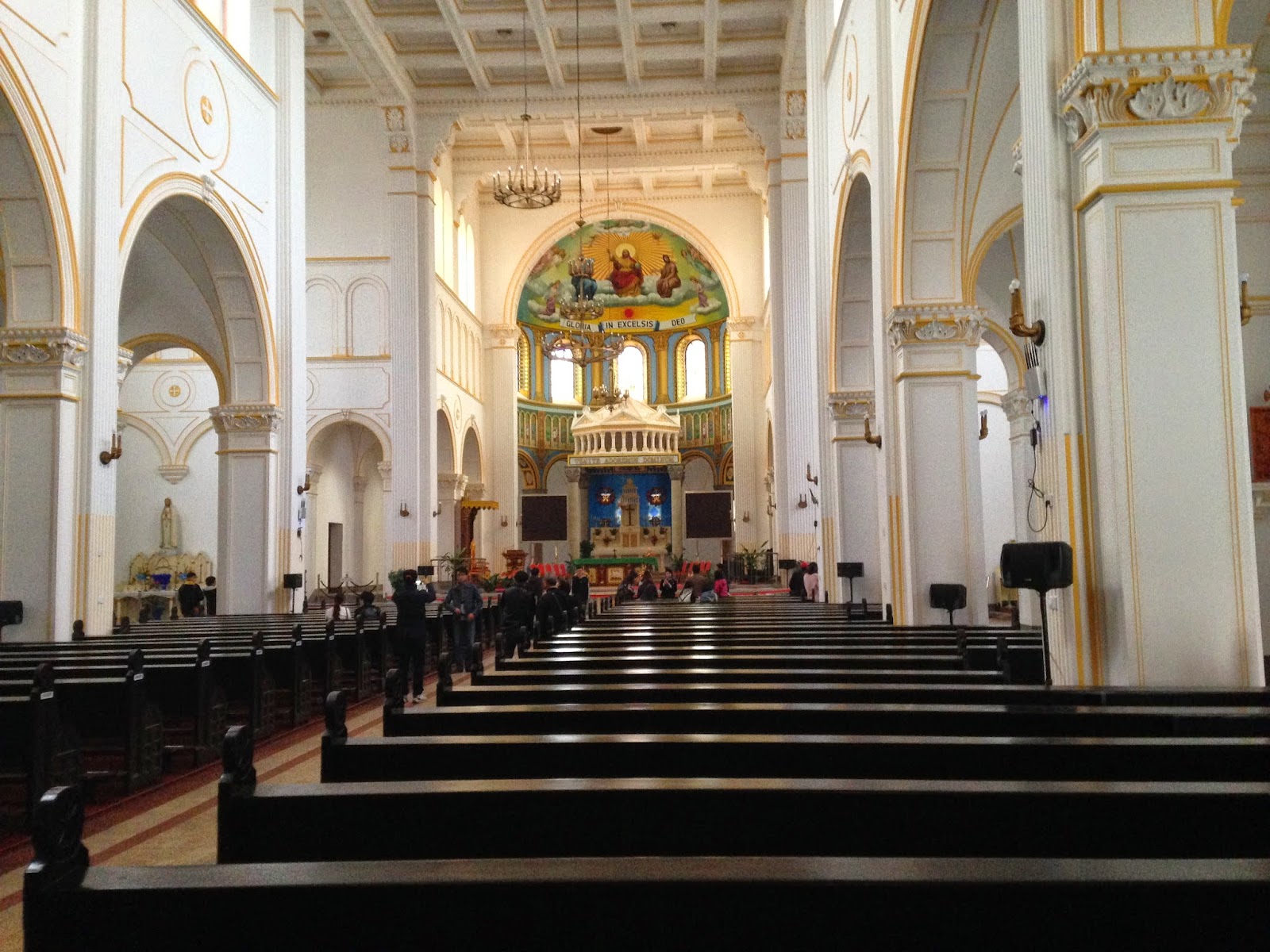
St. Michael's Cathedral, Qingdao, China


Built on a hilltop by the German Catholic Divine World Missionaries (Societas Verbi Divini, SVD) in 1934.  Father Alfred Fräbel designed the neo-Romanesque structure.  Construction was halted in 1933 when Hitler prohibited transfer of money overseas, although Qingdao was then under Chinese control (ROC).

St. Michael's Cathedral has survived two World Wars and a Cultural Revolution with only minimal damage.  In 1942, during the Japanese occupation of Qingdao a banner was hung above the main entrance that read “Under Management of the Japanese Army”.  However, during Mao's Cultural Revolution (1966–1976) members of the Red Army defaced parts of Bishop Georg Weig's tombstone that was set into a wall in the north transept as well as cutting the two crosses off the top of the steeples.  St. Michael's Cathedral 2400 pipe organ, one of the two largest in Asia, was also destroyed.

The Chinese government subsequently repudiated the Cultural Revolution and funded the cathedral's restoration efforts.  New crosses were manufactured for the cathedral's restoration, and after several years of repair, St. Michael's Cathedral was re-opened in April 1981.  In May 1999 the Catholic Protestant Church was opened to the general public, allowing entry when mass or other services are not being held.


adjacent to Square